 written by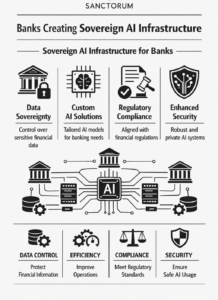
The global banking sector is entering a new phase of technological sovereignty. Financial institutions are no longer satisfied with outsourcing intelligence to third party artificial intelligence vendors. Instead, they are aggressively building sovereign AI ecosystems that they can fully control, audit, and secure. This shift is not just a technical upgrade. It is a strategic realignment driven by regulatory pressure, geopolitical fragmentation, and the rising value of proprietary data.
At its core, sovereign AI refers to AI systems that are developed, deployed, and governed within a controlled jurisdiction or organization. For banks, this means owning the full stack. From data pipelines and model training environments to inference layers and compliance frameworks, everything is designed to operate within strict internal or national boundaries.
The Rise of Financial AI Sovereignty
The urgency behind sovereign AI is rooted in data gravity and regulatory scrutiny. Banks sit on some of the most sensitive datasets in the world. Transaction histories, credit behaviors, identity records, and behavioral signals form a high value digital asset base. Sending this data to external AI platforms introduces unacceptable risks.
Recent regulatory developments across regions have intensified this concern. Data localization laws, AI governance frameworks, and financial compliance mandates are pushing institutions toward in house AI capabilities. Sovereign AI is no longer optional. It is becoming a compliance necessity.
At the same time, the competitive landscape is shifting. Fintech startups and neobanks are leveraging AI native architectures to deliver hyper personalized financial services. Traditional banks are responding by building their own AI engines that can match or exceed these capabilities without compromising control.
Why Third Party AI Is No Longer Enough
Third party AI platforms offered speed and scalability in the early phases of AI adoption. However, they come with structural limitations that are increasingly problematic for banks.
First, there is the issue of data exposure. Even with encryption and privacy guarantees, external processing introduces potential vulnerabilities. Second, there is model opacity. Banks cannot fully audit or explain black box models developed by external vendors, which conflicts with regulatory requirements for explainability.
Third, there is strategic dependency. Relying on external AI providers creates long term vendor lock in. In a world where AI capabilities define competitive advantage, this dependency becomes a strategic liability.
Sovereign AI addresses all three issues by bringing intelligence back in house.
The Architecture of Sovereign AI in Banking
Building sovereign AI is not just about training models internally. It requires a reimagined architecture that integrates multiple advanced components.
One key element is federated learning infrastructure. This allows banks to train models across decentralized datasets without moving sensitive information. Another is secure compute environments such as confidential computing and hardware level encryption, ensuring that data remains protected even during processing.
Banks are also investing in domain specific foundation models. These are large language and predictive models trained exclusively on financial data. Unlike generic AI systems, they understand the nuances of risk assessment, fraud detection, compliance, and customer behavior in banking contexts.
In addition, explainable AI frameworks are becoming central. Regulators demand transparency in decision making, especially for credit scoring and fraud detection. Sovereign AI systems are being designed with built in interpretability layers to meet these requirements.
Strategic Advantages of Sovereign AI
The move toward sovereign AI unlocks several strategic advantages for banks.
Control is the most obvious benefit. Banks can define how models are trained, validated, and deployed. This ensures alignment with internal risk frameworks and regulatory expectations.
Customization is another major advantage. Sovereign AI allows institutions to tailor models to their specific customer base, market conditions, and product offerings. This leads to more accurate predictions and better customer experiences.
Resilience is also critical. In an era of geopolitical uncertainty and fragmented digital ecosystems, relying on external AI infrastructure can be risky. Sovereign AI provides operational independence and reduces exposure to external disruptions.
Finally, there is the innovation multiplier effect. Once banks establish their own AI platforms, they can rapidly experiment with new use cases such as real time fraud detection, autonomous financial advisory, and predictive liquidity management.
Emerging Trends Driving the Shift
Several emerging trends are accelerating the adoption of sovereign AI in banking.
AI nationalism is reshaping the global technology landscape. Countries are encouraging domestic AI development to reduce reliance on foreign technology providers. Banks, as critical national infrastructure, are aligning with this trend.
Synthetic data generation is also gaining traction. Banks are using AI to create realistic but non sensitive datasets for training models. This reduces privacy risks while maintaining model performance.
Another key trend is the convergence of AI and cybersecurity. As AI systems become more powerful, they also become targets. Sovereign AI allows banks to integrate advanced security measures directly into their AI pipelines.
Finally, the rise of edge AI in financial services is enabling real time decision making closer to the data source. This is particularly relevant for fraud detection and transaction monitoring, where milliseconds matter.
Challenges and Complexities
Despite its advantages, building sovereign AI is not without challenges.
The cost of infrastructure is significant. Developing and maintaining high performance computing environments requires substantial investment. Talent is another constraint. There is a global shortage of experts who can design and manage advanced AI systems within highly regulated environments.
There is also the challenge of scalability. Banks must ensure that their sovereign AI systems can handle massive volumes of data and transactions without compromising performance.
Moreover, governance becomes more complex. Owning the entire AI stack means taking full responsibility for ethical considerations, bias mitigation, and regulatory compliance.
The Future of Banking Intelligence
The shift toward sovereign AI signals a broader transformation in how banks perceive technology. AI is no longer just a tool. It is becoming a core strategic asset, comparable to capital and liquidity.
In the future, we can expect banks to operate as AI driven platforms where decision making is increasingly automated, personalized, and predictive. Sovereign AI will serve as the foundation for this transformation, enabling institutions to innovate while maintaining control and trust.
Banks that successfully build and scale their sovereign AI capabilities will not only gain a competitive edge but also redefine the standards of security, transparency, and intelligence in the financial industry.