
 written by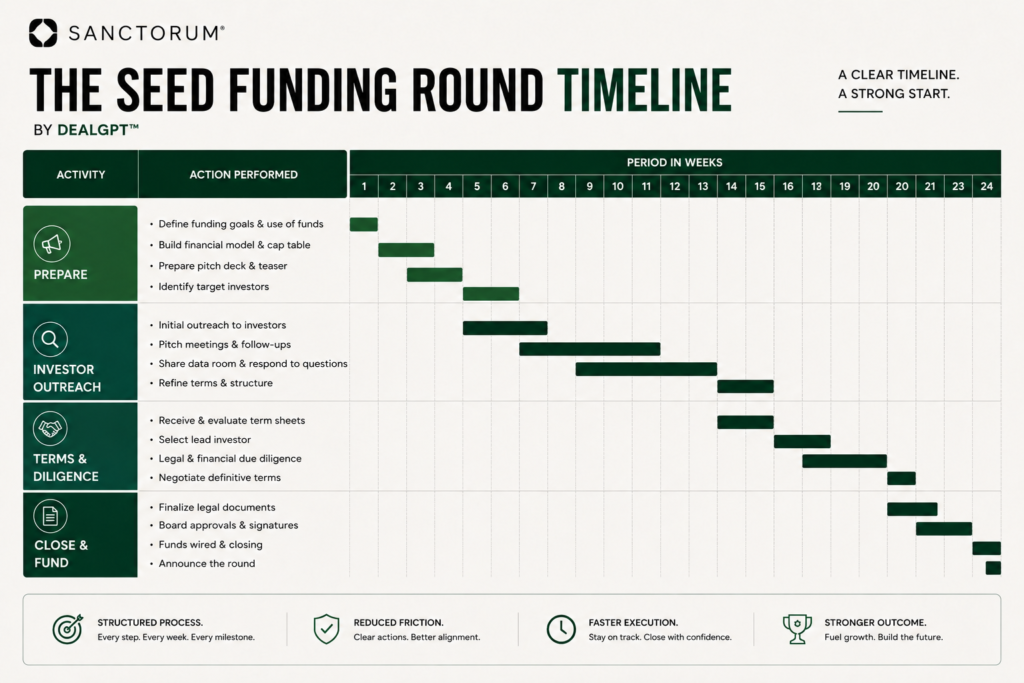
Raising capital is one of the most legally demanding milestones in a startup’s journey. While founders often focus on refining their pitch deck and meeting investors, the success of a funding round is ultimately determined by the quality of its legal documentation and due diligence. From incorporation records and cap tables to shareholder agreements, term sheets, intellectual property assignments, employment contracts, board resolutions, regulatory filings, and closing documents, a single investment round can involve hundreds of pages of legal material.
Traditionally, reviewing these documents has required significant time from founders, investors, lawyers, and consultants. AI legal assistants are now transforming this process by automating document analysis, legal research, contract comparison, compliance reviews, and due diligence preparation, allowing legal professionals to focus on judgement, negotiation, and strategy rather than repetitive administrative work.
Unlike general-purpose AI chatbots, modern legal AI platforms are increasingly connected to trusted legal databases and enterprise knowledge repositories. Internationally, lawyers rely on platforms such as LexisNexis, Westlaw, Practical Law, and Bloomberg Law. In India, legal professionals frequently use research platforms including Manupatra, SCC Online, Taxmann, and AIR Online to access case law, legislation, regulatory guidance, and legal commentary. These databases remain the authoritative source of legal information, while AI provides a faster and more intuitive way to search, summarise, compare, and analyse the information they contain.
For startup fundraising, an AI legal assistant can add value throughout the entire investment lifecycle.
Before fundraising, it can generate first drafts of NDAs, SAFE agreements, convertible notes, founder agreements, ESOP documentation, subscription agreements, and legal data room checklists. Rather than starting from a blank page, founders and lawyers begin with structured drafts that can be reviewed and customised.
During due diligence, AI dramatically reduces manual review time by organising uploaded documents, identifying missing records, detecting inconsistencies across agreements, extracting key obligations, and producing investor-ready summaries. Instead of manually reading hundreds of pages, founders and investors can ask natural language questions such as:
- Who currently owns the company’s intellectual property?
- What liquidation preference has been proposed?
- Are there any drag-along or tag-along provisions?
- Does the shareholders’ agreement contain restrictive veto rights?
- Which due diligence documents are still outstanding?
Rather than searching across dozens of PDFs, the AI delivers source-backed answers linked directly to the relevant clauses.
During negotiations, AI can compare competing term sheets, explain complex legal provisions in plain English, benchmark clauses against market standards, identify founder-friendly and investor-friendly terms, estimate dilution under different scenarios, and prepare structured redlines for legal counsel. While the final negotiation always rests with experienced lawyers and investors, AI significantly reduces the time required to identify the issues that matter most.
After signing, AI continues to assist by monitoring compliance obligations, maintaining organised document repositories, tracking board approvals, reminding teams of filing deadlines, and making executed agreements instantly searchable for future financing rounds.
This is where DealGPT differentiates itself from conventional legal research tools. Platforms such as Manupatra or SCC Online are exceptional resources for finding legal authorities, precedents, and statutory material, but they are not designed to manage an end-to-end investment transaction. DealGPT combines legal intelligence with corporate dealmaking workflows. It enables founders, investors, lawyers, accountants, and advisors to collaborate within a single AI-native workspace where research, document analysis, due diligence, communication, negotiation, and transaction management are connected.
Using natural language, users can upload thousands of pages of legal and corporate documents and instantly generate due diligence reports, investment memoranda, contract summaries, compliance checklists, risk analyses, board papers, and transaction timelines. Rather than functioning solely as a legal search engine, DealGPT acts as an intelligent operating system for fundraising and corporate transactions.
For enterprise customers, DealGPT can also be deployed within secure private AI environments, ensuring confidential legal documents and commercially sensitive information never leave the organisation’s infrastructure. This is particularly valuable for law firms, venture capital funds, private equity firms, investment banks, family offices, and large corporations handling highly confidential transactions.
AI is not replacing lawyers, nor should it. Legal judgement, negotiation strategy, regulatory interpretation, and professional accountability remain firmly in human hands. Instead, AI legal assistants are becoming force multipliers that eliminate repetitive document review, accelerate legal research, improve collaboration, and surface insights that might otherwise take days to uncover.
As startup funding becomes increasingly competitive and document-intensive, the firms that combine trusted legal expertise with AI-powered workflows will complete transactions faster, reduce costs, improve accuracy, and allow founders to focus on what matters most: building great companies rather than managing paperwork.