 written by
As artificial intelligence reshapes industries at unprecedented speed, a new fault line is emerging beneath the surface of innovation: control. Who owns the models? Where does the data reside? And who ultimately governs the intelligence that drives decisions, capital, and power?
In this shifting landscape, a new category is taking shape, sovereign AI, and a rising contender is positioning itself at its center: Sanctorum.
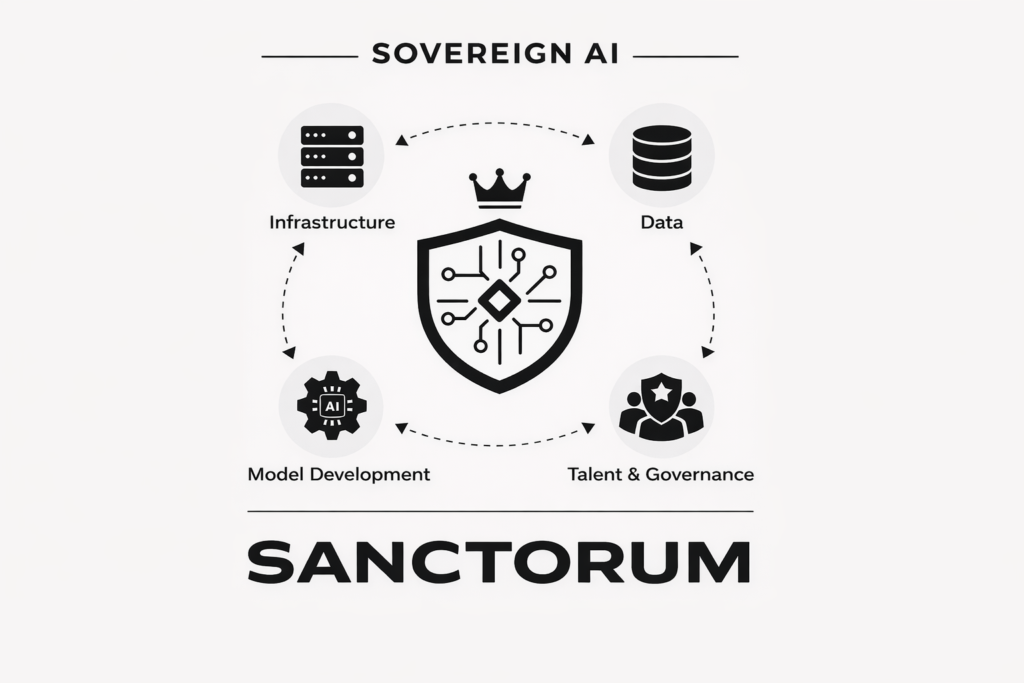
“Sovereign AI is either a country’s or an organization’s capacity to independently develop, deploy, and govern artificial intelligence using its own infrastructure, its own data, its own models, and its own talent. It is not about owning the technology. It’s about retaining full control over the entire AI life cycle, from the physical compute to the algorithmic logic.” – McKinsey
The End of One Size Fits All AI
For the better part of a decade, artificial intelligence has been dominated by centralized platforms, powerful, scalable, but fundamentally generic. These systems have democratized access to AI, yet they have also exposed a growing limitation. They are not built for specificity, control, or high-stakes execution.
Enterprises today are no longer satisfied with AI that merely assists. They require systems that align with proprietary strategies, operate within regulatory boundaries, and integrate seamlessly into mission-critical workflows.
This is where Sanctorum diverges.
Rather than offering AI as a service, it delivers AI as infrastructure, custom-built, privately deployed, and deeply integrated into the operational core of institutions.
From Intelligence to Execution
Much of today’s AI ecosystem revolves around generating insights, summaries, predictions, and recommendations. But insight alone does not create value. Execution does.
Sanctorum’s philosophy reflects a broader evolution in artificial intelligence, the transition from conversational systems to transactional systems.
Instead of stopping at analysis, its platforms are designed to:
- Identify opportunities
- Connect relevant stakeholders
- Facilitate decision-making
- Enable the execution of complex transactions
This shift transforms AI from a passive assistant into an active participant in economic activity.
Building the Sovereign Stack
At the heart of Sanctorum’s approach is a vertically integrated model that combines three traditionally separate layers:
- Infrastructure – Dedicated computing environments and proprietary models tailored to specific institutional needs
- Intelligence – Domain-specific AI trained on unique datasets and workflows
- Execution – Tools that enable real-world actions, from collaboration to capital deployment
By unifying these layers, Sanctorum is effectively creating a self-contained intelligence ecosystem, one that operates independently of external platforms and aligns fully with its users’ strategic objectives.
Why Sovereignty Matters Now
The timing of this approach is no coincidence.
Across industries and governments, concerns around data privacy, regulatory compliance, and geopolitical risk are intensifying. AI is no longer just a technological asset. It is becoming a strategic one.
Three forces are accelerating the demand for sovereign AI:
- Regulatory pressure. Stricter data governance frameworks are forcing organizations to rethink where and how AI operates
- Competitive advantage. Proprietary models trained on unique data are becoming key differentiators
- Operational risk. Dependence on third-party AI systems introduces vulnerabilities that institutions can no longer afford
In this context, owning the full AI stack is not a luxury. It is a necessity.
The Emergence of AI-Native Capital Systems
Perhaps the most ambitious aspect of Sanctorum’s vision lies in its application to finance.
Traditionally, dealmaking has been fragmented, research in one place, communication in another, execution somewhere else. This fragmentation creates inefficiencies, delays, and missed opportunities.
Sanctorum aims to unify these processes into a single, AI-driven environment where:
- Information is continuously analyzed
- Networks are dynamically activated
- Transactions are executed with greater speed and precision
The result is the early blueprint of what could be described as an AI-native capital system, a platform where intelligence and capital move together.
A Market on the Brink of Transformation
The implications extend far beyond finance.
As industries become more data-driven and interconnected, the demand for custom, sovereign, and execution-oriented AI systems is expected to grow rapidly. Organizations will increasingly seek solutions that are not only intelligent but also aligned, secure, and outcome-focused.
Sanctorum’s positioning places it at the intersection of several powerful trends:
- The decentralization of AI infrastructure
- The rise of vertical, domain-specific intelligence
- The convergence of software, networks, and capital
The Road Ahead
The future of artificial intelligence will not be defined solely by scale or capability, but by ownership, alignment, and impact.
In that future, the most valuable systems will not be those that answer questions, but those that drive outcomes, systems that are embedded, sovereign, and inseparable from the organizations they serve.
Sanctorum is betting that this future is closer than it appears.
And if the trajectory of AI continues on its current path, it may well be right.