 written by
 The State of AI Alpha: Insights for Institutional Allocators

Executive Summary
The current landscape of AI in institutional investing is characterized by a significant gap between marketing claims and empirical reality. As of Q3 2026, research indicates that most “AI alpha” is an illusion, often masking simple market and factor exposure or relying on the memory of training data rather than genuine predictive skill. To navigate this environment, allocators must shift their focus from the AI model itself—which has become a commodity—to the “underneath layer” of proprietary data, compute infrastructure, and rigorous verification processes.
Critical Takeaways:
- The Model is Not the Edge: Any model can be rented by a competitor. True advantage lies in un-rentable assets: proprietary data, energy contracts, and massive compute clusters built over years.
- Verification is the Primary Hurdle: AI has made generating answers cheap but checking them expensive. Automated summaries and trading agents frequently produce confident but structurally flawed outputs.
- Diligence is Currently Inadequate: The average allocator scores 31/100 on AI-specific diligence. Traditional checks fail to detect biases, “memory” effects, and specification errors that cause models to collapse when moving past their training cutoffs.
- The SPEC Framework: Effective evaluation requires a shift to the four axes of Specification, Performance, Explanation, and Configuration to distinguish between a “story” and a robust investment process.
I. The Anatomy of AI Failure in Finance
Research suggests that the vast majority of AI-driven investment claims do not survive rigorous empirical testing. The failure modes are often invisible to traditional due diligence.
1. Contaminated Research and Methodology
The volume of AI finance research has exploded—from 36 papers in 2023 to 250 in 2025—but methodological rigor has not kept pace.
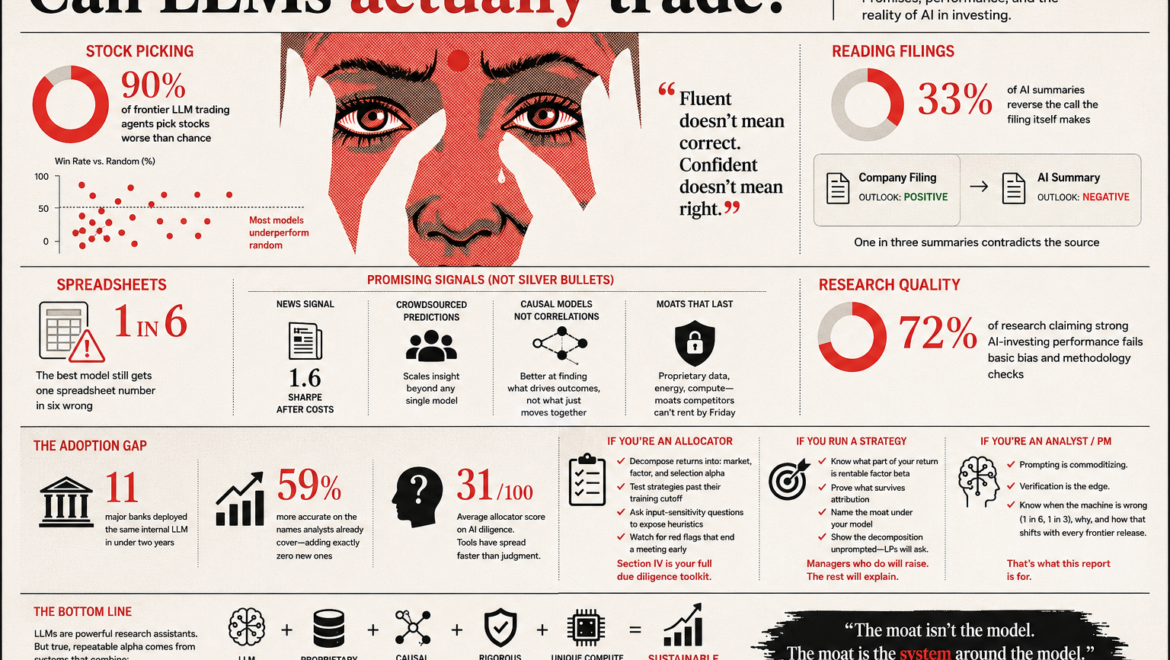
- Bias Neglect: A review of 164 papers found that 72% leave core biases unaddressed.
- Survivorship Bias: Only 1.2% of analyzed papers properly account for survivorship bias.
- The Skill Illusion: In the KTD-Fin benchmark, 9 out of 10 frontier LLM trading agents showed negative stock-selection alpha. The “top” performer (85% return) actually picked stocks worse than chance; its returns were entirely attributed to market exposure (+42%) and factor tilts (+29%), with a -1% contribution from actual skill.
2. Failure on Fundamental Tasks
Frontier AI models often fail at the tasks required of a junior analyst.
- The Spreadsheet Ceiling: While models can score 82.4% on simple financial spreadsheets, accuracy drops to 48.6% (below a coin flip) when handling complex workbooks involving multiple funds and companies.
- The Summary Reversal: In a study of S&P 100 filings, LLMs reversed the investment call (e.g., turning a bullish document into a bearish summary) in one-third of cases. These summaries were fluent and plausible, hiding the fact that they dropped critical caveats.
3. Factor Mirages and Specification Errors
Statistical diagnostics can be misleading. Adding a “control” variable that is actually a consequence of the factor and returns can flip a factor’s sign (e.g., from +0.08 to -0.04) while simultaneously improving R-squared and p-values. Traditional backtesting cannot catch these errors of causal assumption.
II. Pathways to Sustainable Alpha
While many claims fail, specific structural approaches to AI continue to provide a genuine edge.
1. Un-rentable Moats: Data, Energy, and Compute
The durable edge has migrated “down the stack” away from software and toward physical and proprietary assets.
| Entity | Moat / Asset |
| Hudson River Trading | Proprietary data center; 100TB+ of proprietary market data; massive GPU reserves. |
| XTX Markets | €1B+ data center in Finland (22.5 MW); 25,000+ GPUs; 650 petabytes of storage. |
| High-Flyer | Integrated GPU infrastructure used for both price prediction and LLM training (DeepSeek). |
2. Crowdsourced Ecosystems
Platforms like Numerai demonstrate that a “metamodel” built from thousands of independent, stake-weighted submissions can consistently outperform internal models. The moat here is not a single model, but the infrastructure and game theory that aggregates diverse intelligence.
3. Causal Infrastructure
The ability to distinguish correlation from causation is becoming an infrastructure-level advantage. Organizations like ADIA Lab have developed simulation environments that generate tens of thousands of synthetic datasets to test causal-discovery models. In this context, the institutional edge is the simulation engine, while the specific model used by contestants is secondary.
4. Implementation Realism
The “frictionless” headline Sharpe ratio for AI news signals (often cited at 3.1) typically settles at 1.6 when adjusted for large-cap universes, value-weighting, and transaction costs. The genuine gain often comes from a ~70% reduction in volatility rather than increased returns.
III. The Industry Adoption Gap
The financial industry is adopting AI rapidly, but this adoption is largely focused on “table stakes” rather than competitive advantages.
1. Research Acceleration
Major firms have moved past pilots to full production for internal workflows:
- Lord Abbett: Reduced backtest failure rates and cut weeks of work down to days.
- Balyasny: Automated central-bank speech analysis, reducing a 2-day task to 30 minutes.
- IDX Advisors: Saved $1M+ over three years by automating legal and administrative tasks.
2. The “Floor” Effect
Between 2023 and 2025, almost every major bank (Morgan Stanley, JPMorgan, Goldman Sachs, etc.) rolled out internal LLM tools. Because these tools are being adopted simultaneously across the industry, they represent a “new floor” for productivity rather than a source of alpha.
3. The Breadth/Depth Problem
AI tools help analysts deepen their coverage of existing names (reducing forecast error by 59%), but they do not help analysts expand their breadth to cover new companies. Analysts tend to use AI as a “cheat-sheet” to speed up current tasks rather than to discover new opportunities.
IV. The SPEC Due Diligence Toolkit
To bridge the gap between allocator capability and manager claims, the SPEC framework provides four axes for interrogation.
The Four Questions for AI Managers
- Specification (S): “How did you decide which variables to include/exclude?”
- Strong Answer: Theoretical justification and formal selection with held-out data.
- Concern: Inclusion based solely on past performance/backtesting.
- Performance (P): “Walk me through a time your model was wrong. What did you change structurally?”
- Strong Answer: Identification of a broken structural assumption and a subsequent logic fix.
- Concern: Blaming the market or only “tuning” parameters.
- Explanation (E): “Walk me through a specific trade from last quarter. Which signals fired and why?”
- Strong Answer: Reconstruction of the decision in economic terms.
- Concern: Deflecting to aggregate performance (the “black box” excuse).
- Configuration (C): “What happens when you remove one variable? How sensitive is the model?”
- Strong Answer: Systematic robustness testing; the model degrades but does not collapse.
- Concern: Performance collapses or the manager is evasive about sensitivity.
Maturity Levels of AI Diligence
- Level 1 (Face Value): Trusting the brochure and familiar model names.
- Level 2 (Buzzword Screen): Separating labels from systems; knowing what tools are used (Average allocator level).
- Level 3 (Track-Record Diligence): Traditional performance attribution; blind to data leakage or contamination.
- Level 4 (Structured Questioning): Using the SPEC framework to hear evasion versus substance.
- Level 5 (Falsifiable Testing): Independently running blinded re-executions and model swaps.
V. Operational Recommendations
For Allocators
- Decompose the Track Record: Strip out market and factor exposure to find genuine selection alpha. Re-run tests past the model’s training cutoff to ensure the “edge” isn’t just memory.
- Audit the Verification Step: Determine who—or what—checks the AI’s output. An unchecked output is a liability.
- Identify Un-rentable Advantages: Focus on managers who own their data pipelines and compute infrastructure rather than those just “renting” frontier models.
For Strategy Managers
- Framework Alignment: Present performance and process using the SPEC axes (Specification, Performance, Explanation, Configuration).
- Transparency of Skill: Clearly show selection alpha net of factors and provide evidence of robustness past training data cutoffs.
- Efficiency Metrics: Quantify the “cost per validated signal.” True edge lies in the infrastructure that runs models cheaply and checks them honestly.